


Geometry as ride feel
Tony Corke's VERA AR
In the world of carbon monocoques, customisation is still almost a paradox. Most frames are produced in a fixed mould: geometry is a consequence of size, not a choice made by the cyclist. Those who want a high-performance carbon bike learn to adapt by adjusting the height and position of the saddle, changing the stem, or replacing the handlebars. But the frame remains unchanged. At Gregario, the starting point is different: each frame is created from a specific set of measurements, and the geometry adapts to them through an in-house parametric CAD system.
Parametric design applied to frame geometry
When we receive biomechanical measurements from a new client, the process does not begin with choosing a reference size. It begins with analysing those measurements to generate the input parameters for the model. This parametric model, developed internally, adapts each frame’s geometry to individual body proportions.
It was at this stage, during the preparation of the project for Tony Corke, that the bottom bracket (BB) drop came into play as an active variable. The BB drop directly influences the centre of gravity of the rider-bike system, cornering response, and high-speed stability: its adaptability within the parametric model allows these characteristics to be optimised regardless of the rider’s size.
Dialogue and iterations to find the perfect geometry
With over twenty years of experience in professional bike fitting and hundreds of custom bikes designed, Tony’s approach to geometry is grounded in technical literature on the dynamic behaviour of two-wheeled vehicles, empirically verified over his career. When he contacted us regarding his VERA AR, he had a clear vision of the dynamic behaviour he was seeking.
The first two proposals were polar opposites. Proposal 1 was the most conventional configuration: a 120 mm stem, a 73° head angle, a 595 mm front centre, and a 60 mm trail. These parameters were geared towards stability and a predictable directional response.
Proposal 2 pushed to the opposite extreme: a 100 mm stem, a 74° head angle, a 605 mm front centre, and a reduced trail of 54 mm. This was a low-stability setup with immediate directional response to any rider input. Tony described it with a direct analogy: like flying a fighter jet. Precise, engaging, with no margin for error.
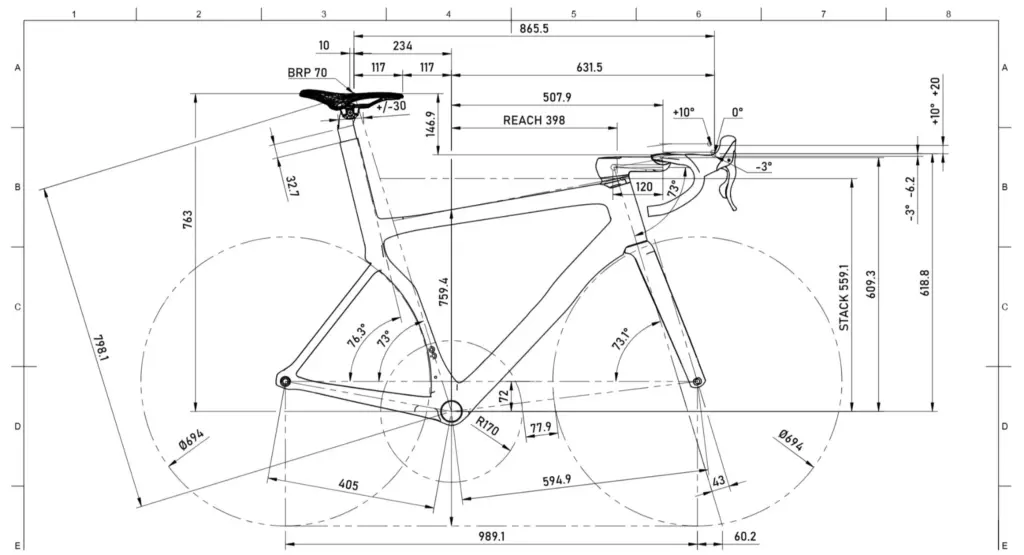
Proposal #1
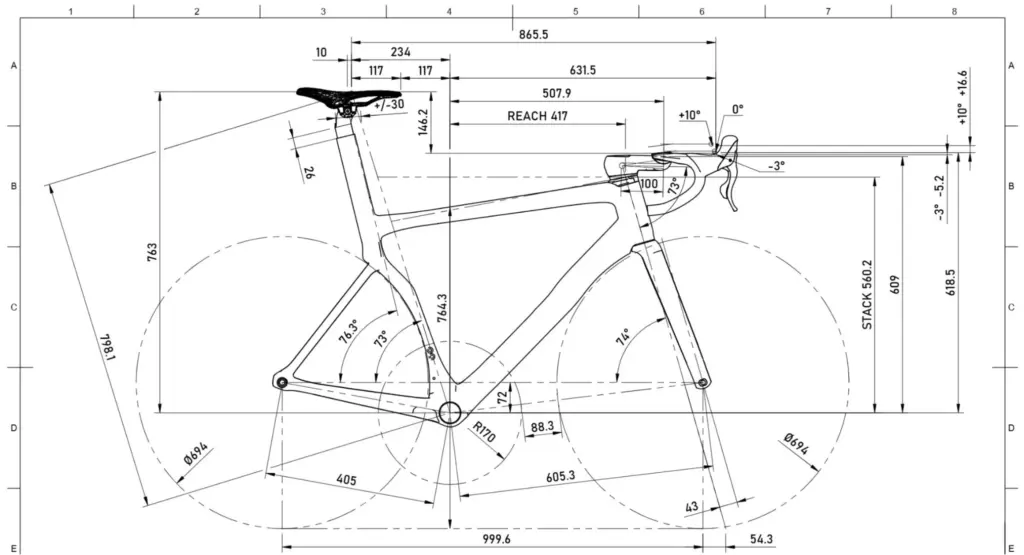
Proposal #2
His counter-proposal was positioned between the two extremes with clear logic: a 110 mm stem, a 73.5°/74° head angle, and a 75 mm BB drop. This configuration leans towards a reactive response without reaching the instability of Proposal 2. Having accepted his feedback, and taking the opportunity to update our parametric system with a variable BB drop, we developed the final proposal.
Ride feel as a design parameter
This is the crux of the matter. In the road bike market, technical debate focuses predominantly on weight, stiffness, and aerodynamics. Product comparisons revolve around watts saved, frame weight in grams, and wind-tunnel CdA values. While these are crucial data points that should not be underestimated, a bike’s dynamic behaviour (how it corners, how it reacts to external disturbances, and how much effort the rider needs to maintain a line) is often overlooked. Yet this is what determines whether a bike is genuinely effective or merely impressive on paper.
Head angle and trail are the parameters that, more than any other, define the dynamic character of a road bike. Trail is the distance, measured on the ground, between the point where the steering axis intersects the ground and the contact point of the front tyre. It quantifies the tendency of the front wheel to re-centre after a disturbance: higher values produce a stable, linear response, while lower values increase sensitivity to rider inputs, reducing self-stabilisation. Front centre (the horizontal distance between the centre of the bottom bracket and the front axle) and chainstay length determine weight distribution between the two axes, directly impacting rear traction and front-wheel load during braking and cornering.
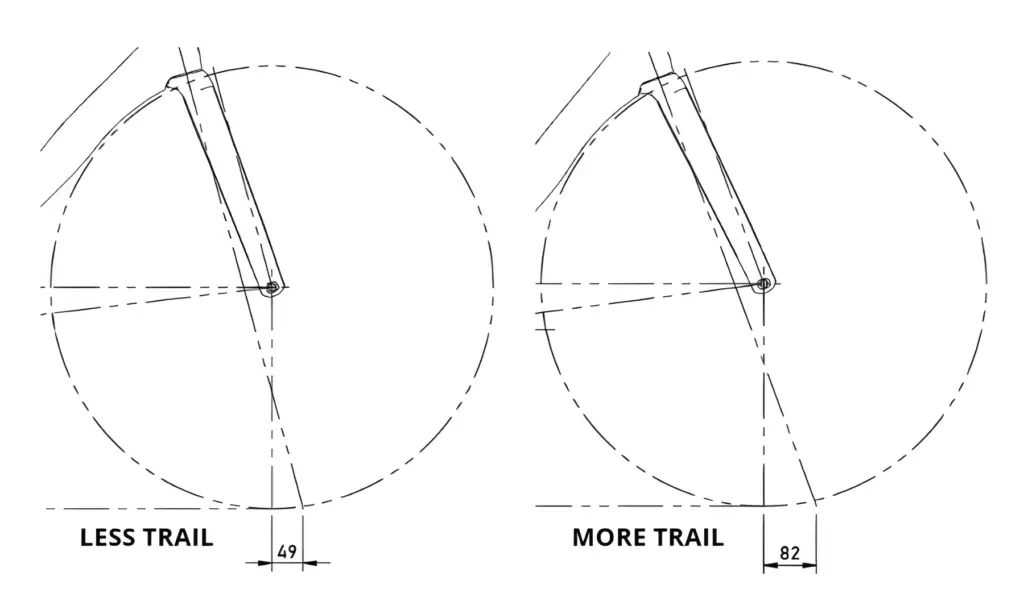
The final geometry of Tony’s VERA AR sets the head angle at 73.1° with a trail of 60.4 mm, a value broadly aligned with Proposal 1 (60 mm), but achieved through a very different combination of overall parameters: a shorter stem, a 75 mm BB drop, and a revised front centre. It is the combination of parameters that defines dynamic character, not trail in isolation.
Every parameter is a response to a specific dynamic behaviour requirement, not to a frame size.
Final geometry
Head angle: 73.1°
Trail: 60.4 mm
BB drop: 75 mm
Chainstay length: 405 mm
Front centre: 597.4 mm
Wheelbase: 990.7 mm
Stack (at frame): 570.5 mm
Reach: 397 mm
Seat tube angle: 75.9°
Stem: 110 mm
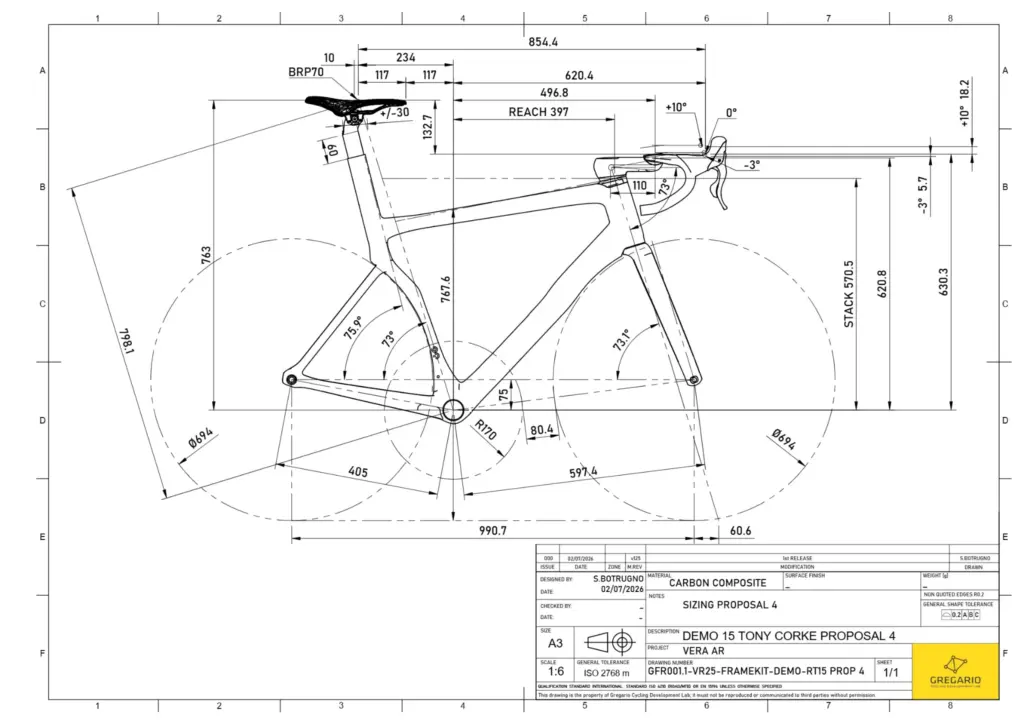
Proposal #3 – Final geometry drawing
The bike will be delivered to Tony in a few days. Stay tuned to our channels to see the finished build.